
What is a golden sample?
A golden sample is an identified, approved physical unit that the buyer, supplier and inspector can use as a reference for agreed characteristics. A signed sample might define how a surface should look or how two parts should fit. The controlled drawing, specification and test criteria establish the measurable requirements. Record which document governs if the sample and written specification appear to conflict, then resolve that conflict before releasing the order.
Ask whether the unit represents what the supplier will make in bulk. A hand-finished prototype can help you approve shape and feel. Ask what will change when the supplier switches to production tooling, the intended material or the actual assembly process. One formal example comes from U.S. federal procurement. An optional first-article clause requires the sample and production units to come from the same facility. For a commercial order, agree which conditions the sample needs to represent. U.S. Federal Acquisition Regulation, first-article approval clause and Alternate I
1. Check how the sample was made
Before reviewing the unit, ask the supplier to list its material and finish, production site, tooling or process used, and the drawing and packaging revisions. Ask for a list of temporary substitutions or hand operations. Decide which characteristics can be approved now and which need a unit from the intended production setup.
If there are multiple SKUs, document exactly which variants the sample covers. For instance, one unit can represent a shared fit dimension while each color requires its own finish reference. For a furniture order, use the furniture sample review guide to plan checks specific to that product.
2. Review against written criteria
Use the sample and the specification together. Record what you reviewed, the method, what you found and the decision for each open item.
| Check | What to record |
|---|---|
| Identity and traceability | Sample ID, SKU or variant, date, factory or production site, and drawing revision |
| Dimensions and fit | Critical measurements, tolerances, measured results and the method or fixture used |
| Material and appearance | Material grade, finish or color reference, viewing conditions and permitted visual variation |
| Function | How the unit is operated, the test method and the required outcome |
| Packaging and labels | Artwork revision, barcode data, label placement, protective pack and carton details where relevant |
| Open deviations | Exactly what differs, which quantity or lot a waiver covers, who approved it and when it expires |
For an appearance judgment, define the viewing conditions and the area being assessed. If a single sample cannot show an acceptable range, agree separate limit samples or a documented reference for the boundary. Photos help identify the sample and locate defects. Use the agreed physical or instrument-based reference for decisions that depend on color, texture or dimensions.
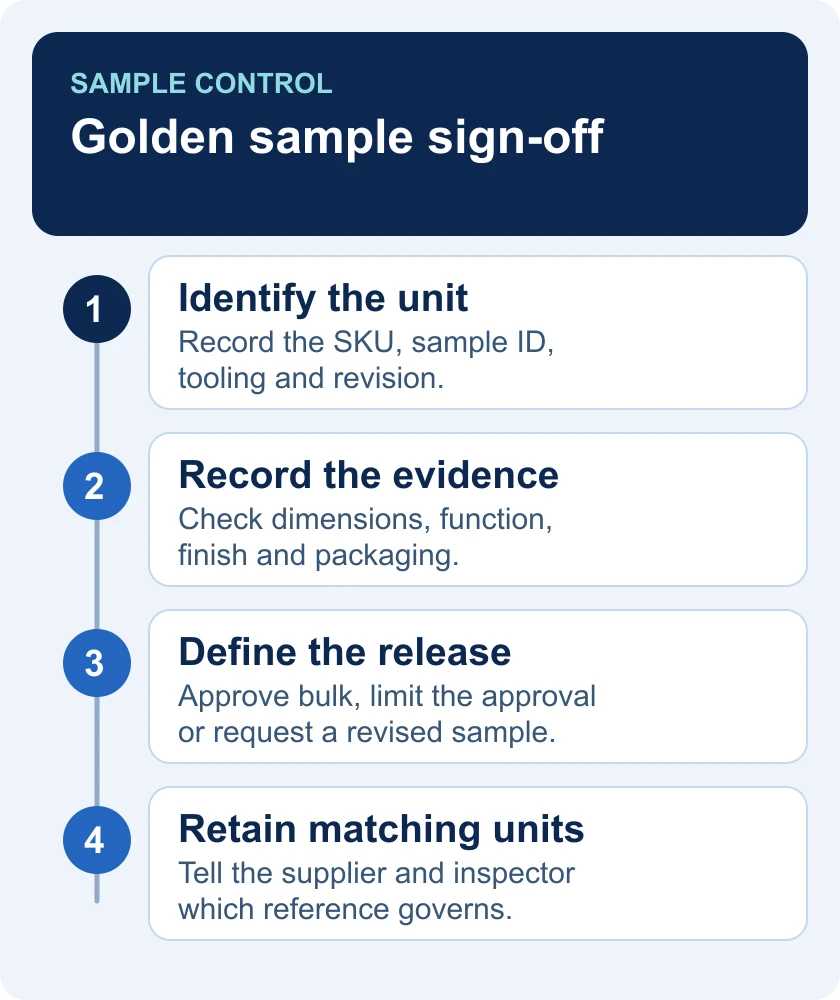
3. Issue a release decision with a clear scope
Use a decision the supplier can act on.
- Approved for bulk production. Identify the exact SKU, revisions and reference sample. List any remaining milestones that apply before production starts.
- Approved for a limited purpose. Name the operation or characteristic you approve, such as artwork or a pilot run. State which work is still on hold and what evidence releases it.
- Revise and resubmit. Give the supplier a numbered correction list, required evidence and a new review date.
For example, if a unit has the right housing but uses a temporary label, the buyer can approve housing dimensions and require a separate review of production labels before packing. Write the restriction into the release record and share it with the person who controls the order on the supplier’s side.
4. Keep controlled references and handle changes
Label retained units with the sample ID, revision, approval date and the buyer and supplier contacts responsible for the record. Photograph the identifier and save the agreed specifications with the approval record. If you and the supplier keep separate units, confirm that they match. Tell the inspector where to find the controlled reference and which traits it governs.
Ask for a change notice before using a new material, tool, site, process or artwork. Review the change against the characteristics it affects and decide whether to approve documents, request a new sample, repeat testing or hold release. Mark the old reference superseded when you approve a replacement. For regulated products, confirm the applicable testing and certification separately. U.S. CPSC testing and certification resources
A sign-off note you can copy
Sample [ID] for SKU [SKU] and PO [number] was reviewed against specification [revision] and artwork [revision]. Decision: [approved for bulk / limited approval / revise and resubmit]. Approved characteristics and variants: [list]. Open deviations and hold points: [list]. Retained units: [holder and location]. Before making any change to an approved characteristic, please obtain written approval. Supplier acknowledgement: [name and date].
Common sample approval questions
Can I approve a sample remotely?
You can approve characteristics that can be verified with the evidence you have. For example, review a label proof against the artwork file. If the decision depends on fit, texture, color or function that you cannot evaluate remotely, arrange a physical review or a documented local check before approving that characteristic.
Does sample approval release the final shipment?
Sample approval establishes a reference and authorizes the work you specify. Agree a separate shipment release decision for the production lot, based on the required inspection results, documents and any corrective action.
Does approving the sample start the lead time?
It can start the clock if the supplier confirms that the other agreed start conditions are complete. Use the supplier quotation guide to align sample costs, approvals and production assumptions before placing the order.
Share your sample requirements with YANCE
Include the product, target variants, the sample stage you have reached, and the tests or approvals your team needs before placing a bulk order.