Agree the shipment decision before production
A pre-shipment inspection (PSI) checks a defined lot against requirements the buyer and supplier have agreed. Buyers can use the report to decide whether to release, hold or rework that lot. To make the report actionable, agree the inspection timing, lot scope, checks, acceptance rules and release authority before production. Put them in the PO or an attached inspection brief that the supplier acknowledges.
1. Define the lot and when it is ready
Identify the purchase order, SKUs and quantities, site and planned shipment. For a partial shipment, identify the quantities and carton ranges included in that release. Confirm when the finished units and cartons will be available for independent selection and whether any units need to be unpacked for testing.
Specify the minimum production and packing status that makes sense for your plan, then ask the inspector to record the actual status on arrival. If some variants are missing or the stock is inaccessible, agree whether to reschedule or issue a limited report that clearly identifies the unchecked quantities. Include time for the report, corrections and reinspection before the carrier cutoff.
2. Write checks that produce a decision
Give the inspector the current specification, packaging files, applicable sample reference and defect list. Turn vague checks such as “good finish” into observations that can be repeated. Use drawings, reference photos or approved limits to show where a defect matters.
| Check | What the inspection brief should specify |
|---|---|
| Quantity and assortment | Expected counts by SKU or variant and how the counts will be checked |
| Workmanship and finish | Observable defects, locations that matter and severity examples |
| Dimensions and function | Critical dimensions, tolerances, test steps, equipment and required result |
| Packaging and labeling | Carton marks, SKU-to-barcode mapping, pack counts and artwork revision |
| Documents and exceptions | Required reports or approvals and what the inspector should flag if evidence is missing |
Set a feasible sample size for each special check, such as destructive or time-intensive testing. Agree when testing needs separate equipment, earlier production samples or a qualified lab. Treat lot inspection and required compliance evidence as separate release inputs. For products subject to U.S. consumer product safety rules, consult the CPSC’s testing and certification guidance.
3. Set the sampling and defect rules
If you use acceptance sampling, specify the standard and edition, lot definition, inspection level, applicable sampling scheme and severity rules. Agree how to count defects or nonconforming units, and who confirms the acceptance and rejection numbers for the resulting plan. Ensure the inspector can select a random sample from the defined lot, with coverage of variants or carton locations as agreed.
ISO 2859-1:2026 describes AQL-indexed sampling schemes for lot-by-lot inspection by attributes. AQL means acceptance quality limit. Use it as an input to an agreed sampling scheme. To decide the lot’s disposition, apply the plan’s acceptance and rejection criteria to the sample results. A passing sample carries sampling risk and cannot establish the exact defect rate in the shipment. ISO 2859-1:2026 · NIST Engineering Statistics Handbook
Define what happens when a critical or safety-related issue is found. If your brief calls for a hold on any observed critical defect, state the escalation owner and which stock must be isolated. Where an issue requires prevention controls, lab evidence or a separate verification step, agree those in advance. A clean sample can still miss a rare issue.
4. Name the person who can release the goods
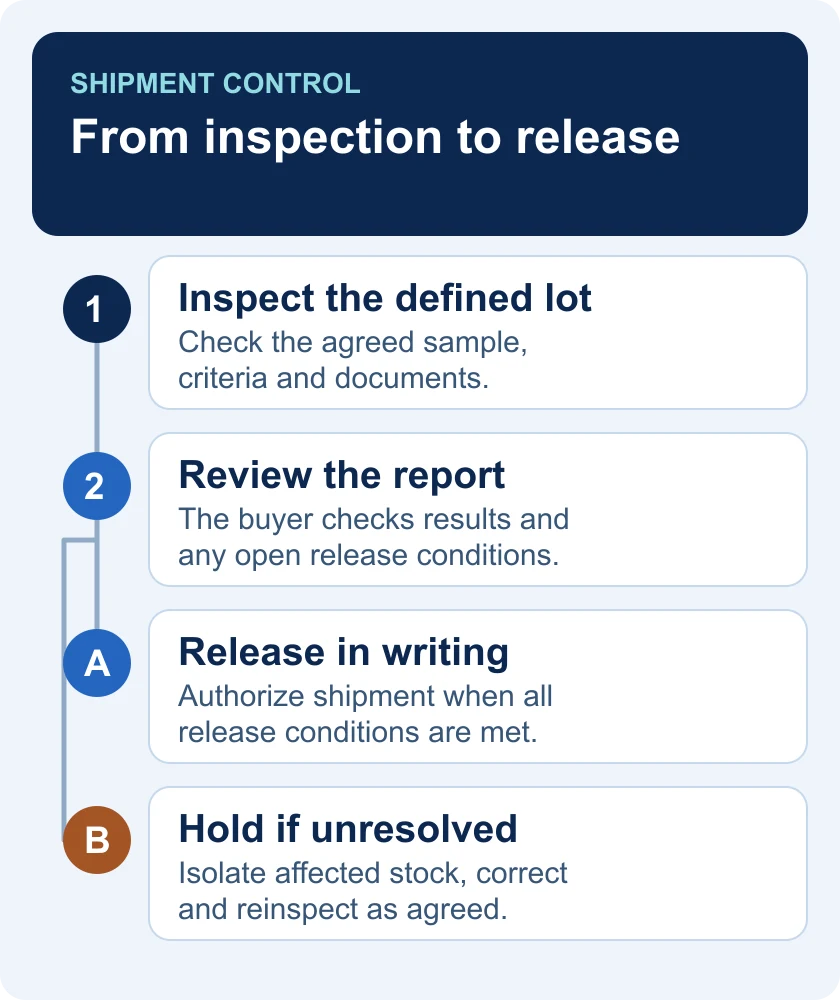
Give the inspector responsibility for reporting and name the buyer representative who decides shipment release. Require the report to show the lot inspected, actual sample sizes, defects by class, test results, photos, any unavailable checks and the inspection outcome. Match the report to the planned shipment before issuing written release.
If a lot is rejected or a required check could not be completed, identify the affected stock, put the release on hold and request a corrective plan. Agree who sorts or reworks the goods, who pays for reinspection under the order terms and how the inspector verifies the corrected lot. If the buyer approves a concession, identify the exact defect and quantities covered and record the authorization. Carry unresolved compliance requirements through the separate compliance process.
Copy this inspection brief into your order
PO and revision: [number]. Lot and location: [SKUs, quantities, cartons and site]. Ready condition: [finished and packed quantities, access and date]. References: [specification, sample ID, artwork and defect list]. Checks and sampling: [methods, plan and edition, levels, acceptance and rejection rules, special tests]. Report due: [date and time zone]. Hold and correction process: [stock segregation, evidence and reinspection]. Shipment release owner: [name or role].
Common inspection questions
What should I do if the shipment is split?
Define each release lot before the inspector visits. Identify its SKUs, quantities and carton marks, then decide what inspection evidence is required for each release. Track which cartons were checked so later goods cannot be mistaken for the inspected lot.
Can a pre-shipment inspection replace an in-process check?
Use an in-process check when a characteristic becomes difficult to inspect after assembly or when correction at the end would be costly. Reserve the final inspection for the checks it can perform on the finished lot. The guide to verifying a Chinese manufacturer covers supplier checks before you place the order. The quotation comparison guide explains how to surface inspection expectations while comparing offers.
Share your inspection requirements with YANCE
Include your product specification, order quantity by SKU, destination, critical checks, and the inspection-ready and handover dates you are targeting.