1. OEM vs ODM: The Difference Buyers Need to Know
In a typical OEM arrangement, the buyer provides the core product design or detailed specifications, while the manufacturer produces accordingly. In a typical ODM arrangement, the manufacturer provides or develops a product design that the buyer may adapt and market under an agreed arrangement. These labels do not automatically determine design ownership, customization rights or quotation scope. Buyers should confirm those responsibilities in writing before placing an order.
Usage varies by industry and contract. A supplier advertising both services has not necessarily demonstrated the engineering capability your product needs. Treat the label as the beginning of a discussion, rather than a complete specification.
2. OEM vs ODM Comparison Table
| Decision | Typical OEM starting point | Typical ODM starting point |
|---|---|---|
| Product design | Buyer-led design | Manufacturer's existing or proposed design |
| Specifications | Buyer supplies requirements; factory reviews feasibility | Factory supplies a baseline; buyer confirms changes |
| Customization | Defined by drawings and agreed engineering work | Limited by the platform and permitted modifications |
| Engineering responsibilities | Allocate design review, testing and production engineering | Allocate adaptation, development and testing |
| Tooling and development fees | Quote project-specific work separately | Confirm existing tooling access and modification charges |
| Sample approval | Check against the agreed specification and revision | Check the selected baseline and approved changes |
| Intellectual property | Document existing rights and ownership of new work | Document licenses, restrictions and new development rights |
| Quotation assumptions | Confirm drawing version, materials and tolerances | Confirm model, configuration and included customization |
Neither model is automatically cheaper or better. Compare a defined scope before comparing prices.
3. How to Choose the Right Manufacturing Model
A. You have a complete design. Share controlled drawings, materials and performance requirements. Ask which processes are in-house, which need subcontracting and who handles production engineering. An OEM discussion should establish whether the factory can manufacture your specification consistently.
B. You want to adapt an existing product. Identify the manufacturer's model and list changes to branding, materials, functions or packaging. Ask what is configurable, what requires development and what you are permitted to sell. An ODM quotation should identify the exact starting configuration.
C. You have a concept. Separate design services, feasibility, prototypes and manufacturing into agreed stages. Joint development can involve different rights and fees at each stage; one OEM or ODM label cannot describe every responsibility.
Use the manufacturer shortlisting guide and YANCE Factory Network to identify candidates, then check their fit for the actual project.
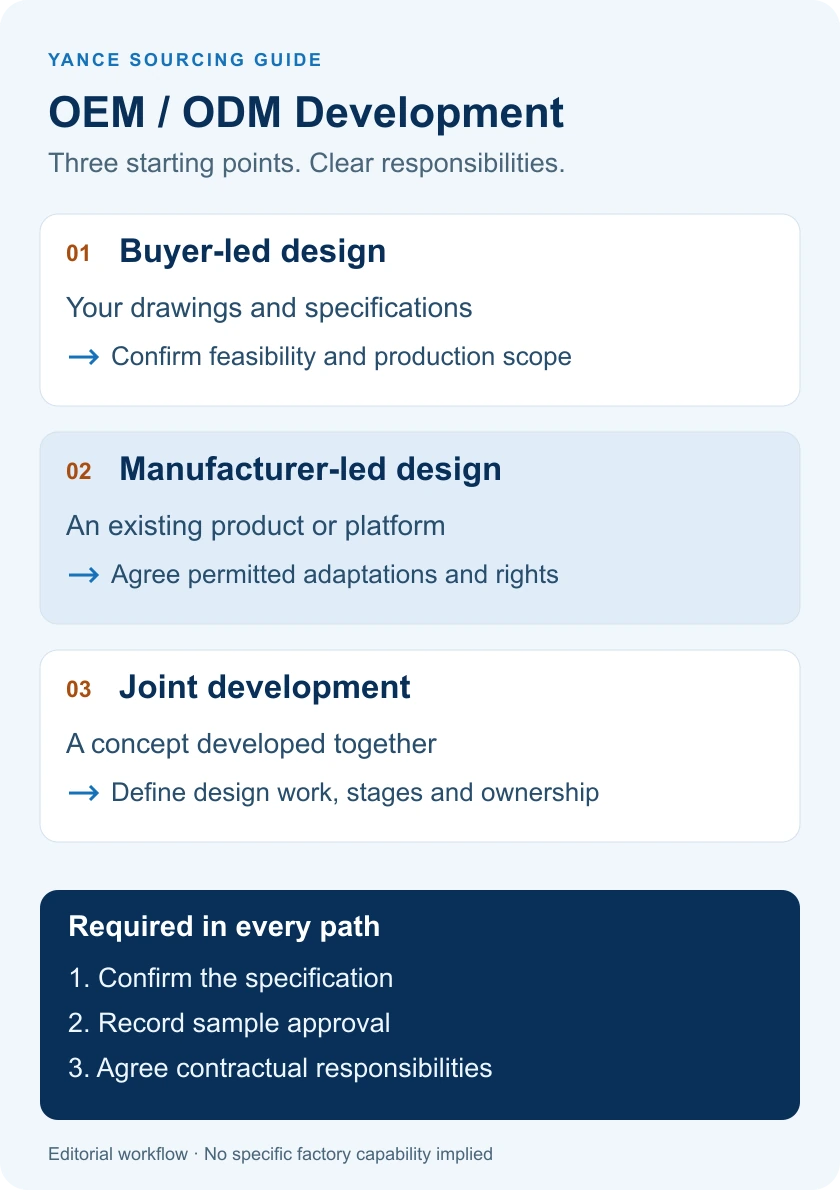
Editorial workflow illustration. These are project-planning paths, not evidence of a specific factory's capabilities.
4. What to Include in an OEM or ODM RFQ
Copy this checklist into your inquiry. Replace general answers with measurable requirements and identify anything still undecided.
| RFQ field | Question to ask the manufacturer |
|---|---|
| Product category and intended use | Can you manufacture [product] for [intended use], and what relevant processes do you operate? |
| Target market and destination | What information do you need to quote for delivery to [market and destination]? |
| Design ownership and specifications | Which drawings or specifications do you need, and how will our existing design rights be protected? |
| Product reference and customization | Which existing model matches this reference, and which requested changes require new development? |
| Materials, dimensions and performance | Can you meet [materials, dimensions, tolerances and performance], and what exceptions apply? |
| Branding, labeling and packaging | What branding, labeling and packaging are included in your quotation? |
| Quantity by model and variation | What MOQ applies separately to each model, color, material and packaging variation? |
| Samples and approval | What sample version will you provide, and how will we document approval? |
| Tooling and development costs | Which mold, tooling and non-recurring engineering charges apply, and when are they payable? |
| Testing and market compliance | Which destination-market requirements need review, and which tests and documents are included? |
| Delivery milestones | What starts each milestone, and which dependencies could change the schedule? |
| Quotation scope and terms | Can you state the Incoterm, named place, payment terms, validity and all exclusions? |
For variation-level purchasing commitments, use the MOQ guide. Avoid presenting an aggregate quantity as a confirmed MOQ for every configuration.
5. Costs Buyers Should Clarify Before Comparing Quotes
Separate unit price from development, molds, samples, packaging, testing and later modifications. Ask whether sample fees are credited, how design changes are charged and whether quantities affect component purchasing or packaging commitments.
Request written amounts, assumptions and payment milestones. A quotation based on existing components is not comparable with one that includes new engineering. Record exclusions as carefully as included items, and use one specification revision across suppliers. Our quotation comparison guide explains how to compare the commercial scope beyond unit price.
6. Who Owns the Design and Tooling?
WIPO's supplier IP guidance recommends clarifying existing intellectual property, rights in newly developed work, permitted use and confidentiality in writing.
Distinguish the buyer's background designs from the manufacturer's existing platform and any improvements created together. Agree who receives editable design files and whether manufacturing rights are exclusive or limited. Define permitted use of branding and confidential technical information.
Treat physical tooling separately: identify ownership, identification marks, storage, maintenance, access, permitted production use and transfer arrangements when cooperation ends. Paying a tooling charge does not by itself resolve every ownership question.
The International Trade Administration's China IP guidance also notes that protection in another country does not automatically confer protection in China. Obtain qualified professional review for complex IP or manufacturing agreements; this checklist is procurement guidance, not a legal guarantee.
7. Sample Approval and Production Readiness
Identify each sample by model, revision, materials, dimensions, finish, packaging and test requirements. Record approval and outstanding changes in writing. A prototype may use different processes from production, so ask what the sample does and does not demonstrate.
Before release, agree how changes will be approved and how the production reference is retained. Confirm whether lead time starts after the written order, deposit, complete technical information, material availability, sample approval or a combination. Separate development, sampling, production and shipping milestones; do not assume an unqualified “30 days” covers them all.
8. Ready-to-Send Supplier RFQ Message
The following is a buyer template, not a YANCE customer case. Replace every bracketed field before sending.
Hello [supplier team],
We are sourcing [product] for [target market], with delivery to [destination]. Our estimated first order is [quantity], split across [models, colors and packaging variations].
We need [manufacturing to our specifications / adaptation of your existing model / joint product development]. Available information includes [drawings, specifications or product reference]. Required customization covers [materials, dimensions, performance, branding and packaging].
Please confirm feasibility, processes handled in-house, MOQ by variation and any requirements needing clarification. We require [sample type and quantity], with written approval before production.
Please itemize unit price, development, tooling, samples, packaging and testing. State the Incoterm and named place, payment milestones, quotation validity, exclusions and the conditions that start each lead time.
Also explain design-file access, tooling ownership and permitted use of existing or newly developed designs. Please identify any assumptions or proposed alternatives before quoting.
Thank you, [buyer name / company].
9. Frequently Asked Questions
Is ODM the same as private labeling?
They can overlap. Private labeling may involve branding an existing product, while ODM can include product adaptation or development. Confirm the actual work and rights.
Is OEM always more expensive than ODM?
No. Cost depends on specifications, tooling, development, quantity and testing. Compare equivalent scope and total commitments.
Who owns the tooling?
Use an explicit written agreement. Identify the physical tools, ownership, use, maintenance and transfer terms instead of relying on the invoice label.
Can a manufacturer support both OEM and ODM?
Yes, but confirm its capability for your category and required engineering work rather than relying on a marketing description.
What should buyers confirm before paying for samples?
Confirm the specification revision, deliverables, fees, approval process, permitted design use, timing dependencies and how the sample relates to production.
10. Next Step: Share Your Sourcing Requirements with YANCE
YANCE helps overseas buyers coordinate factory screening, supplier communication, samples, production follow-up and quality coordination in China. The agreed project defines the service scope; no manufacturing model guarantees a particular result.
Explore our sourcing services, then send your product, destination, quantity and customization requirements as text. The current RFQ does not accept attachments; our team can discuss further technical information during follow-up.