
When does the clock start?
Manufacturing lead time starts at the milestone agreed with your supplier. That may be written order acceptance, confirmation of a deposit, release of the final specification, or completion of several prerequisites. The purchase order date alone tells you little unless the supplier confirms that it starts the quoted clock. Ask the supplier to name both the start event and the end milestone, then confirm them in the order acknowledgement.
For a buyer sourcing from China, “30 days” can describe anything from an approved order to packed goods ready for inspection. It can also describe production after materials are already on site. Oracle’s planning model separates preprocessing, processing and postprocessing. Use those categories to ask which activities the quote covers. Oracle manufacturing lead-time documentation
Confirm which conditions release the order
Ask the supplier to separate conditions that start the clock from activities included after it starts. If several conditions must all be met, request a written start confirmation when the last one closes.
| Possible condition | What to confirm in writing |
|---|---|
| Purchase order | Which PO revision must be accepted, by whom, and how acknowledgement is recorded |
| Deposit | Whether the trigger is payment initiation or receipt confirmed by the supplier |
| Specifications | Which drawing, bill of materials, color reference and tolerances are released |
| Pre-production sample | Which signed sample ID applies and whether approval releases bulk production |
| Artwork and packaging | Which artwork and labels are approved, and whether packaging procurement runs in parallel |
| Materials and production slot | What is in stock, what must be ordered, and whether a line slot is reserved |
If materials are already available, ask which SKU, quantity and lot the availability covers. A supplier might have enough material for one color but still need to procure a custom finish for the rest. Check how MOQ applies by model, color and packaging before asking a supplier to confirm a date for the entire order.
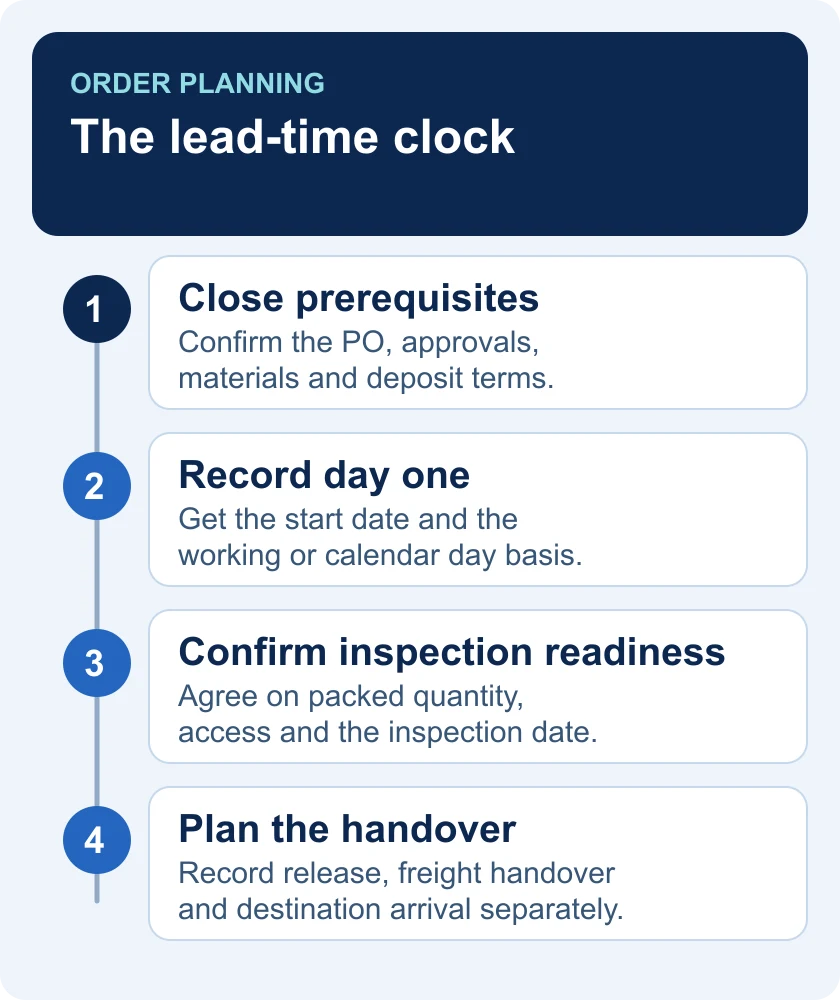
Give each date its own milestone
Use one row per milestone in your planning sheet. Record the owner, prerequisite, target date and evidence of completion. Where two stages overlap, show the overlap so the same days are counted once.
- Development and approvals. Record the dates for tooling, sample revisions and final buyer approval, where applicable. The OEM and ODM sourcing guide explains what to agree about design responsibility before requesting a quote.
- Order release and production. Record the confirmed start date, the calendar basis and the production location. Ask how planned shutdowns or outsourced finishing affect the critical dates.
- Packed and ready for inspection. Agree what “ready” means for quantities, packaging and access to stock. Allow time for the report and any corrective work or reinspection.
- Released for dispatch and handed over. Assign separate dates for the buyer’s release, carrier handover and estimated destination arrival. Confirm which party owns the booking and the transport buffer.
If the quote uses an Incoterms® rule, record the rule, exact named place or port and edition. The delivery point under the chosen rule and the destination can differ, particularly under C rules. Use the ICC’s Incoterms® 2020 checklist when aligning the supplier milestone with the transport plan.
A worked example
Suppose a supplier accepts the PO on 2 June and confirms receipt of the deposit on 4 June. The buyer signs off the sample on 9 June. Both sides agree that all three events are required, that 10 June is day one, and that 20 calendar days ends with the order packed and ready for inspection. On those assumptions, the inspection-ready date is 29 June. The buyer books inspection for 30 June and records a separate provisional handover date, subject to the report and release. These dates are illustrative.
If the sample approval slips by three days, get the new dates in writing. A production slot or component delivery window might also move, so adding three days to the old schedule can give the wrong answer. Ask the supplier to confirm any impact on cost, quantities and which stages can still overlap.
A message you can send to the supplier
Please confirm the lead time for PO [number and revision] and [quantity by SKU]. Which events must happen before day one? Which are already complete? Please state the expected start date, whether you count calendar or working days, and the exact end milestone. Show target dates for packed goods, inspection readiness and handover separately. Please identify buyer approvals, material or capacity dependencies, planned shutdowns and the notice you will give if any milestone changes.
Common lead-time questions
Does a deposit always start manufacturing lead time?
It starts the clock when the written terms say it does and any other required conditions have been met. Ask the supplier to confirm the date it recognized the payment and identify any open approval or capacity condition.
Can a repeat order use the previous schedule?
Use the previous schedule as a starting estimate. Reconfirm materials, line capacity and the drawing and packaging revisions for the new order. Check whether any change requires another sample approval.
How do I compare two different lead-time quotes?
Ask both suppliers to quote to the same endpoint for the same product revision, quantities and packaging. Record assumptions and compare the resulting dates alongside the commercial terms. Use the supplier quotation comparison guide to compare the full offers.
Share your sourcing timeline with YANCE
Include the product, quantities by SKU, destination, approvals still pending and the date you need goods ready. Distinguish that date from the date you need the goods at destination.